People always seem to want to know, “So where are you guys located.” My standard answer is we’re based out of Summerville, SC – near Charleston. This is technically true. My permanent home address is currently 200 Pimpernel Street, Summerville, SC. But I move around a bit. I’m writing this from a temporarily leased apartment in Hanoi, Vietnam. While it is 3:00 AM (I am suffering from jet lag a bit) here it is 3:00 PM back in Summerville. My mother lives in South Carolina and collects the checks, but I have been moving around the past 10 years with my family. My wife, Lisa Nylin, is the main reason we move around.
Lisa works with United Nations Development Program. She essentially helps countries to set up institutions that support human rights. She has worked on ombudsman projects, voter representation issues, women’s equal rights, and even access to water rights. Most of these projects have been in Eastern Europe and the former Soviet states in Central Asia. Not many husbands get to say to their wives, “Remember to pick up some Armenian brandy on your next trip.” I am extremely proud of my wife and her work. By supporting her in her job, I feel like I am helping to vicariously contribute to good causes. Read the rest of this entry »
NOTE: This is an area that I will come back to again, and again. I’d love to get your questions or input. I’ll expand on this subject soon.
I am going to discuss the characteristics of typical bungalow columns. “Typical” bungalow columns do not include the wonderful, crazy, and expensive Arts and Crafts beauties that you would find in a Greene and Greene home. Unfortunately, those are outside the scope of most family’s budgets these days. In fact, I am going to have a follow-up post to discuss the best ways of building (or ordering) these today.
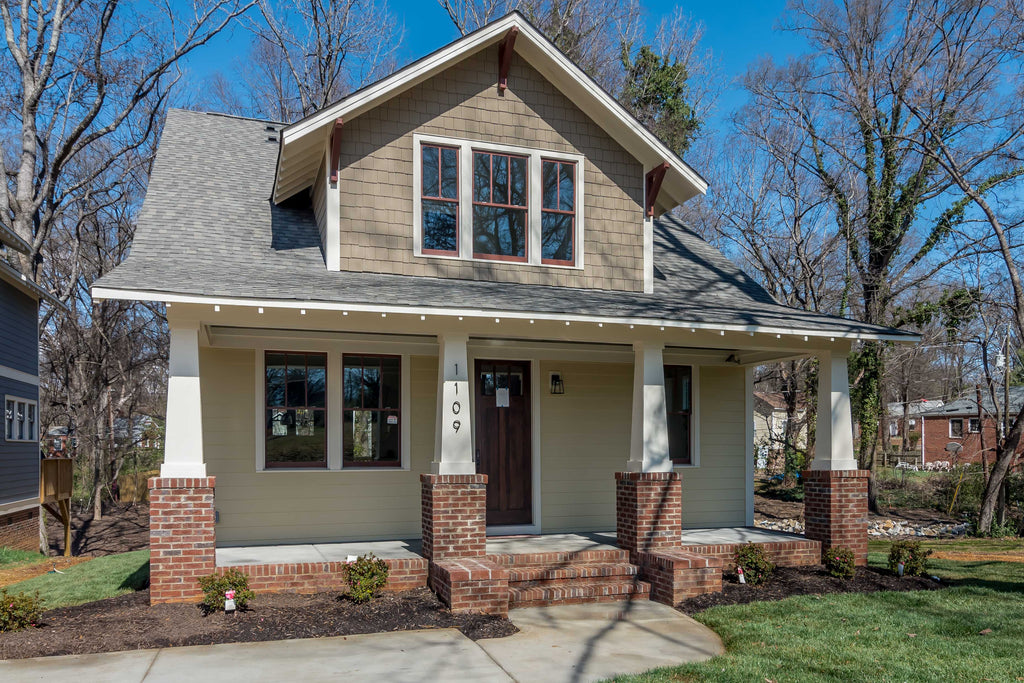
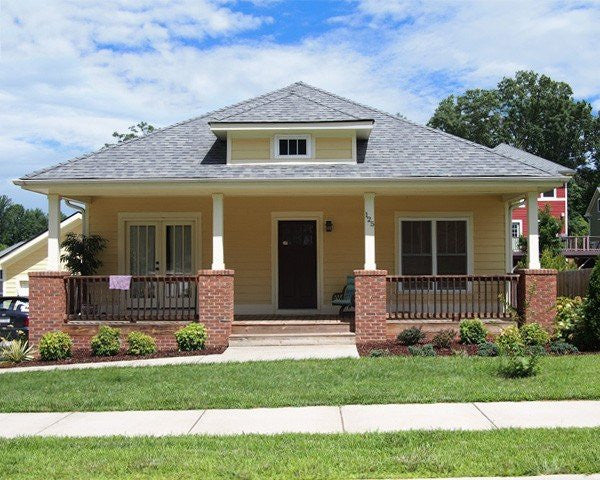
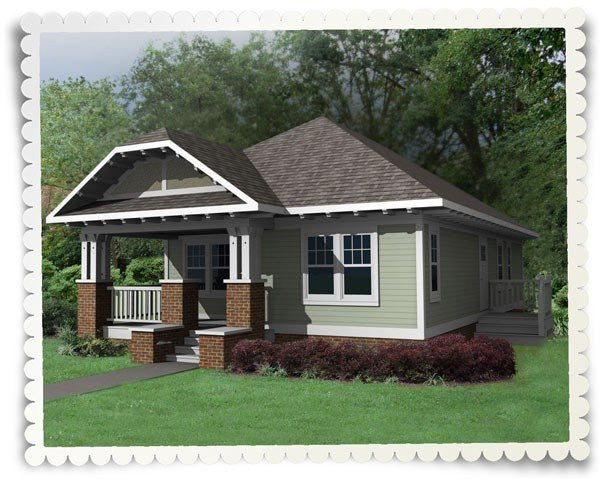
What is the main types of bungalow columns? The classic is the half column on a brick pier. This is seen all over the United States on most every type of bungalow. It comes in an endless variety of types, but I’ll describe the most common: a brick pier about 2’ wide (3 bricks across) topped with either a slab of concrete a turned row of soldier bricks overhanging about 2 inches over the pier. This pier would go up typically waist high or slightly lower. On top of the pier would be a tapered wood column. Not too tapered mind you, approximately 16-18” wide at the bottom and 10-12” at the top. Now you can dress this type of column up or down. A more California look might be to use rounded river stones for the base or to add clinkers (dark burnt bricks) randomly to the brick pier. You could also give the pier a slight taper or battered side. Up on top, you can have a simple square column or perhaps a pair of smaller square columns (4-6” square). Another variant would be to raise the pier to shoulder height and have an interlocking set of square beams as a type of column or a nice fat column, almost a cube.
Speaking of fat columns, you might be wondering, “Why so big?” Well, it just looks right is all I can truthfully say. But there are a few theories… Here is mine. Craftsman bungalows have always been tied to a “get back to basics” mentality. It was in opposition to the frivolity of the Victorian house. To the craftsman folks, the Victorian movement was fraudulent in that it divorced people from nature and the simple life. A craftsman home should be simple, straightforward and honest in its structure. This was most apparent in the use of materials: simple stonework, expressed wood beams, and clear-cut connections. Wood, stone, and earth. The house should sit well on the site. An architectural expression of the connection to the earth was the column. Creating a large stone base that gradually turned into a finished support for a wood column expressed this connection better than anything. So many of the first craftsman homes incorporated this battered stone/brick column device, that it became part of the lexicon.
We’ve been saying this for a while, the papers are starting to catch on…
As lifestyles downsize and the economy suffers, developers are building smaller, cheaper models.
By Nicholas Riccardi, LA Times
The Terraces subdivision here contains rows of 2,000-plus-square-foot homes appointed with sunken tubs, granite countertops and tile floors that stare off into open desert.
But as the economy has contracted, so have the homes.
The development will soon be dotted with new 1,700-square-foot houses on narrower lots that retail for more than $100,000 less than their predecessors.
Though the square footage of new houses tends to dip modestly in recessions, the size of the American home has essentially increased since 1973. But that changed last year, when the size of the typical house suddenly shrunk by 11%. That appears to be faster than at any time since the 1970s.
“People are realizing, ‘Hey, I don’t need the Lexus anymore,’ ” said Wayne Eide of the Development Group, builder of the Terraces. ” ‘I can live with the Camry.’ ”
The National Assn. of Home Builders recently surveyed its members and found 90% of them are building smaller now. Developers cite many factors: increased energy consciousness, empty-nest baby boomers looking to downsize. But the strongest motivator is clearly the sagging economy.
Read the rest of this entry »
A couple of our customers have been checking out the new tax incentives for green housing. One customer of ours if getting a full geothermal hvac unit and solar water heating at the cost of a normal system. This is what he said, anyway… It’s time to check this out.
On-site renewables (solar photovoltaic and hot water systems, small wind systems, and geothermal heat pumps) are now eligible for a tax incentive worth 30% of the total cost, without a cap.
February 17, 2009: Stimulus Package Extends, Enlarges Energy Efficiency Tax Incentives
Here’s a short article in the New York Times concerning new homes and upgrading older homes:
Still looking for ways to lower your taxes? Greening your home means you can get more greenbacks in return. The stimulus plan approved by Congress in February offers tax credits for making your home more energy efficient. For tax tips, the Green Home turned to Kateri Callahan, president of the Alliance to Save Energy, a nonprofit group that advocated some of these credits.
We often get the question, what interior details are provided in the plan package? As a general rule, we tend to keep those details pretty bungalow basic. Most home owners are not capable of paying for Greene and Greene inspired woodworking details and most builders couldn’t execute them. But there can be a nice balance. We do not (currently) provide shop drawings for our built-ins, but we do have nice interior elevations that show the locations, trim, and heights of most details. With the aid of the right book a builder should be able to produce appropriate built-ins to meet your budget and needs.
I was looking for a way to include a relevant post on my favorite Arts and Crafts interior detail book, Shop Drawings for Craftsman Interiors, when lo and behold I got a call from Mike Nutter of QuarterSawn Woodworks in Charlotte, NC. To make a long story short, we are going to design a wonderful, true Craftsman home together.
Read the rest of this entry »
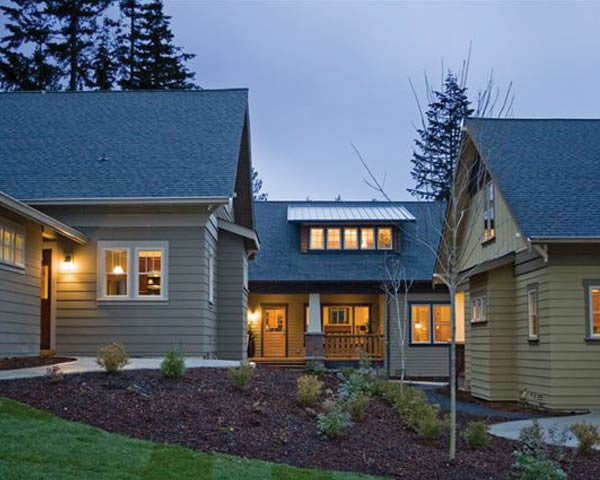
There certainly is a growing contingent of home owners that actually want to interact with their neighbors. This developing demographic (more singles, smaller families, and the empty nesters) are looking out of their windows and discovering that their neighborhoods are boring and lifeless. Not only that, but their front yards are a lot of work but offer no real benefits. Yet they are not willing to give up their single family home security.
Enter the Bungalow Court; which is not a new concept. These have been around since the early 1900’s in various forms. These courts were most popular in California and although the idea is familiar to many people, most have not experienced this type of living in the United Sates. That may be about to change…
So you’re single, divorced with a small kid, or an empty nester. You don’t need that much space but you want to be able to host people when they’re in town. Living alone sometimes is lonely so you want to live in a place where you have the opportunity to make friends. However, you like the idea of owning your own home, therefore apartments are out. The house wouldn’t have to be that big and it would function perfectly – good value.
Read the rest of this entry »
New Homes are Shrinking. Yes!
As discussed in this article in GreenBuildingAdvisor.com, the average new home square footage has declined about 300 square feet in half a year to roughly 2350 sf. That’s still larger than most of our homes, but we are hoping that this is a trend that will continue. From an economic or environmental angle it makes sense, but smaller homes can also encompass more interesting details. And that will hopefully encourage more interest in our smaller bungalow plans. We’ve already been getting many calls from builders who are retooling their plan collections to include smaller homes. If (when) this economic turn down recedes, I hope that people will still be interested in smaller, more efficient, detailed homes. – Brooks Ballard
Read the rest of this entry »
This is the type of feedback that we like to hear…
Since adding your photos to the web, we’ve seen a jump in site traffic and there is a lot of interest in the neighborhood for the green bungalow. Thanks for all your help and we’re excited to be using your plans going forward. Here’s an article that was released today in one of the Fort Worth blogs…
Thanks, Erin Frank
This is from the website Fortworthology, a nice web site devoted to green urban life in Fort Worth Texas.
While we’re on the subject of Joe Frank, I couldn’t help but notice that his next Fairmount infill bungalow, The Rutledge, is now listed on his site. To be built at 1800 Lipscomb, the Rutledge will be 1,408 square feet, 3 bedrooms, 2 baths, and is being listed for $174,500. According to the site, the home has quite a list of features, including:
2×6 shell construction with R.19 wall insulation and R.38 attic insulation
A whole house fan
Radiant barrier decking and paint additive
Low-e wood windows with argon-filled double-pane glass
(more options are listed on site)
I’ve always liked Joe’s work on his previous, larger bungalows, and I can’t wait to see what he does with a smaller and more affordable home. I’ll be sure and tour this one once it’s built. – Kevin Buchanan

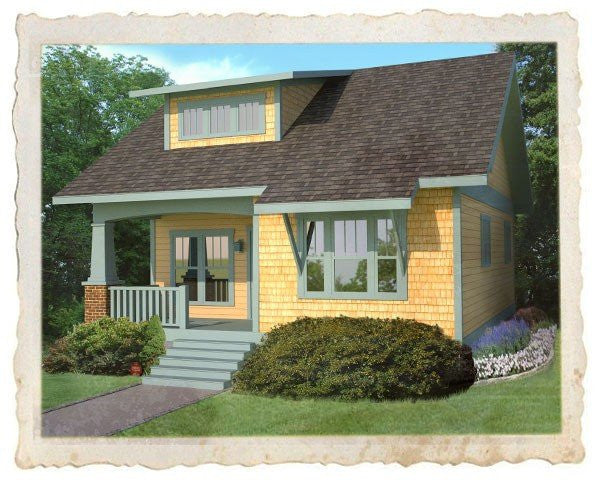
Brackets are one of the defining elements of the bungalow style. They are very easy to build but so often get messed up. Why? Because, like most simple appearing things, they are part of a larger whole. Absolutely any builder could produce a beautifully proportioned bracket. Even I (an all thumbs architect) could make one. But this brings me to one of the rare thoughts that I have actually written down before starting this blog.
“Bracket size affects the roof overhang, which relates to a porch depth, which could determine the overall width for the house, which then affects the set-backs, lot size and rhythm of houses on a street, which could front a public park, which relates to a neighborhood master plan that benefits an entire community. In short, details matter.”
You get the point. If you have a short front overhang, you’re going to have a shorter bracket that will mean a corresponding beam will get too shallow for a historic home. To have a beautiful bracket you need a nicely proportioned home and roof overhang is the element that sets things in motion so to speak. When builders tell me they want to have 12” overhang on a front gable, I immediately know that they do not understand bungalows and are hoping to merely use their current building techniques on a “style”. I understand their concerns about costs, but (at least) on the front elevation, let’s try to get it right. A buyer may not know what exactly feels right about the house, but these small details will win them over and get you quicker sells. That’s what I think.
Things to remember:
In Rob Thallons’ excellent Graphic Guide to Frame Construction, he reminds us that when you notch a barge rafter, that moisture can accumulate on top of the bracket causing the eventual decay of both bracket and rafter. He suggests attaching the bracket to the inside of the barge rafter. At first, I thought that was bit heretical but there are plenty of historic examples to back up his reasoning. On his graphic he deletes the historic looking chamfered appliqué.
A bracket size is directly related to the roof overhang. And a beam size is usually related to the bracket size. Here is a near perfect example. The overhang is roughly 2 feet, maybe a little more or less. The 45 degree bracket comes down to the (almost) middle of the column – good implied force transfer. If you remember your high school geometry class teachings, then you know the beam is roughly 2 feet deep, too.